> ## Documentation Index
> Fetch the complete documentation index at: https://docs.summation.com/llms.txt
> Use this file to discover all available pages before exploring further.
# Excel
> Exec-grade Excel workbooks (.xlsx) Addison builds from your data: models, forecasts, and budgets with live formulas, editable in the app and downloadable as XLSX.
An **Excel** artifact is a spreadsheet workbook (`.xlsx`) that [Addison](/features/addison) builds from your data — a model, forecast, budget, or sensitivity analysis with live formulas rather than pasted numbers. It's a *second-class* artifact: a file in your [project](/features/projects) rather than a native Summation document, but it opens in a full in-app spreadsheet editor and downloads as a standard `.xlsx`.
**Where each action lives in the UI** (for telling users where to click):
* **Opening a workbook**: Excel workbooks are files inside a [project](/features/projects). Open one from the project file list to land in the in-app **spreadsheet editor**.
* **Top bar**: a breadcrumb (project name / workbook name) at the center; a **Version** dropdown and a **⋯** menu at the top-right. The **⋯** menu has **Rename**, **Share**, **Download as XLSX**, and **Delete**.
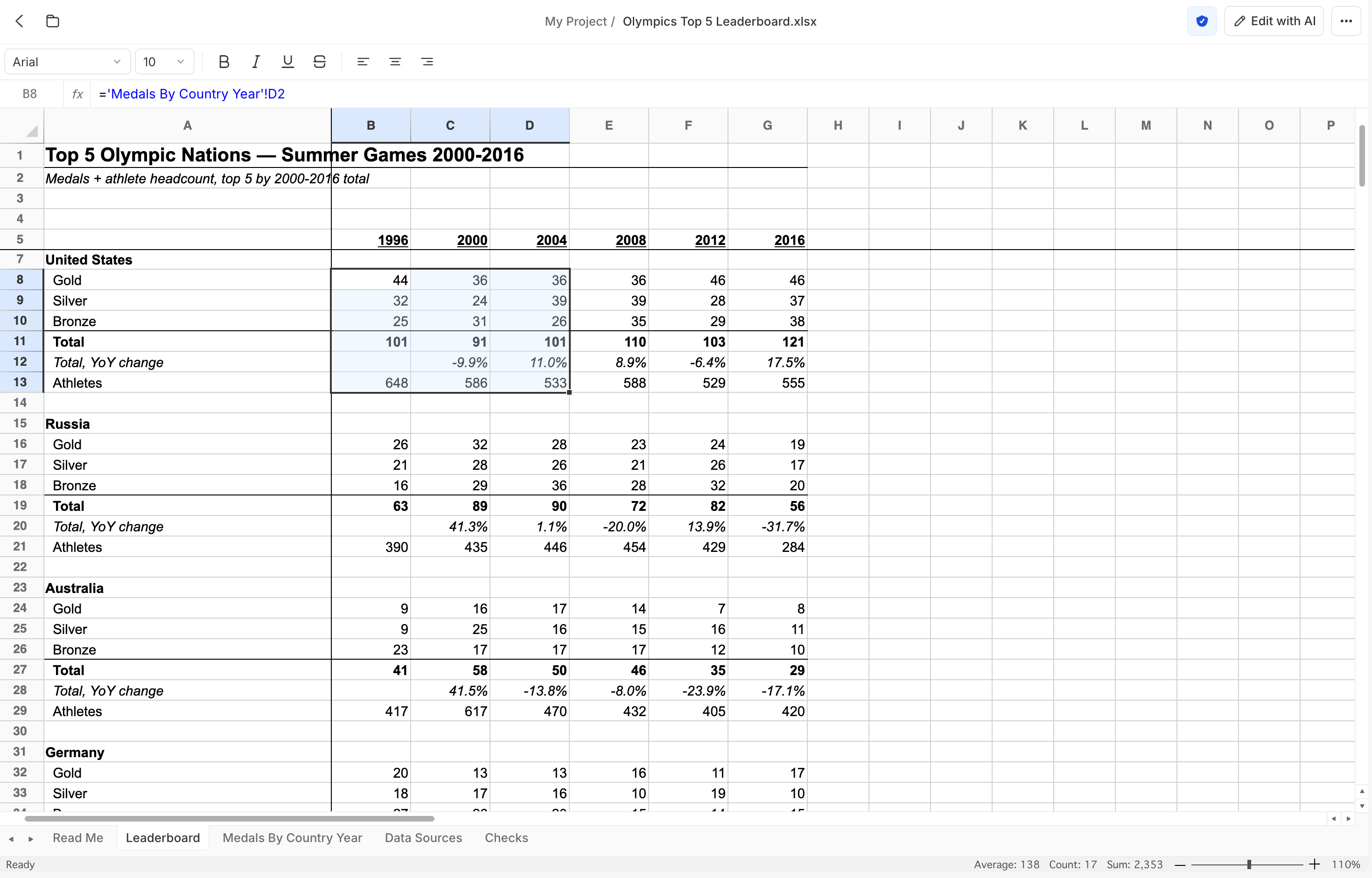
* **Editor**: a formatting toolbar (font family, size, bold/italic/underline/strikethrough, alignment), a cell-reference box and formula bar (`fx`) beneath it, the cell grid, and sheet tabs (for example **Sheet1**) with a **Ready** status and a zoom control along the bottom.
* **Edit with AI and verification**: the spreadsheet toolbar also carries an **Edit with AI** button — select cells, describe a change, and Addison rewrites that part of the workbook (also available by right-clicking a selection) — and a **Verification Hub** button (shield) that audits the workbook against its `workbook_quality` and `workbook_rubric` checks and shows a pass/fail badge.
* **Creation**: no public endpoint generates a workbook. Addison builds it (its `xlsx` skill), or a [playbook](/features/artifacts/playbooks) produces it. Because the result is a file, it is listed, downloaded, and deleted through the [Files API](/features/projects/files).
 ## What Addison builds
Addison's workbooks are built to exec-grade standards, not raw data dumps:
* **Live formulas** rather than pasted numbers, so the model recalculates when inputs change
* **Linked financial statements** where relevant — 3-statement models, budgets, forecasts, and debt schedules
* **Exec formatting** — accounting number formats, parenthesized negatives, and error-guarded divisions
* **Verifier-checked** before delivery, so the quality rules hold
## Create
Ask [Addison](/features/addison) in a chat for the model or workbook you need, or produce one by running a [playbook](/features/artifacts/playbooks). Addison writes the `.xlsx` into your project and opens it in the spreadsheet editor.
Generate an Excel workbook with Addison.
## Open and edit
Open the workbook to view and edit it in the spreadsheet editor: change cell values and formulas in the formula bar, adjust formatting with the toolbar, and switch between sheets using the tabs at the bottom.
Download the workbook's content.
Create or overwrite the workbook's content. Send the binary `.xlsx` with `encoding: "base64"` — raw bytes corrupt the file — and supply exactly one of `path` or `file_id`.
## Verify and edit with AI
Workbooks are first-class **verification** subjects, not just static files. The spreadsheet toolbar carries an **Edit with AI** button — select cells, describe a change, and Addison rewrites that part of the model (the same action is on the right-click menu) — and a **Verification Hub** button (shield) that audits the workbook against its `workbook_quality` and `workbook_rubric` checks and surfaces a pass/fail badge, the way [reports](/features/artifacts/reports#verify-a-report) and [decks](/features/artifacts/decks) are verified.
## Versions
Each save adds a version. Use the **Version** dropdown in the top bar to see and switch between earlier versions of the workbook.
List and restore workbook versions.
## Manage as a file
A workbook is an ordinary file in your project, so every [file operation](/features/projects/files) applies — move it between folders, copy it to another project, duplicate it, or delete it.
From the **⋯** menu in the top bar (or the file's row in the project file list): **Rename**, **Share**, **Download as XLSX**, or **Delete**.
Download the workbook.
Delete the workbook. Requires `confirm=true`.
Rename, move, copy, and share.
## Promote to a first-class artifact
A common flow is to start with a workbook and then have Addison rebuild it as a first-class artifact — an interactive [dashboard](/features/artifacts/dashboards), a presentation [deck](/features/artifacts/decks), or a verified [report](/features/artifacts/reports). The native document gains data citations, verification, and a dedicated home in the app.
Turn the model into interactive charts and KPIs.
Turn the numbers into a presentation.
Turn the analysis into a verified written report.
## What Addison builds
Addison's workbooks are built to exec-grade standards, not raw data dumps:
* **Live formulas** rather than pasted numbers, so the model recalculates when inputs change
* **Linked financial statements** where relevant — 3-statement models, budgets, forecasts, and debt schedules
* **Exec formatting** — accounting number formats, parenthesized negatives, and error-guarded divisions
* **Verifier-checked** before delivery, so the quality rules hold
## Create
Ask [Addison](/features/addison) in a chat for the model or workbook you need, or produce one by running a [playbook](/features/artifacts/playbooks). Addison writes the `.xlsx` into your project and opens it in the spreadsheet editor.
Generate an Excel workbook with Addison.
## Open and edit
Open the workbook to view and edit it in the spreadsheet editor: change cell values and formulas in the formula bar, adjust formatting with the toolbar, and switch between sheets using the tabs at the bottom.
Download the workbook's content.
Create or overwrite the workbook's content. Send the binary `.xlsx` with `encoding: "base64"` — raw bytes corrupt the file — and supply exactly one of `path` or `file_id`.
## Verify and edit with AI
Workbooks are first-class **verification** subjects, not just static files. The spreadsheet toolbar carries an **Edit with AI** button — select cells, describe a change, and Addison rewrites that part of the model (the same action is on the right-click menu) — and a **Verification Hub** button (shield) that audits the workbook against its `workbook_quality` and `workbook_rubric` checks and surfaces a pass/fail badge, the way [reports](/features/artifacts/reports#verify-a-report) and [decks](/features/artifacts/decks) are verified.
## Versions
Each save adds a version. Use the **Version** dropdown in the top bar to see and switch between earlier versions of the workbook.
List and restore workbook versions.
## Manage as a file
A workbook is an ordinary file in your project, so every [file operation](/features/projects/files) applies — move it between folders, copy it to another project, duplicate it, or delete it.
From the **⋯** menu in the top bar (or the file's row in the project file list): **Rename**, **Share**, **Download as XLSX**, or **Delete**.
Download the workbook.
Delete the workbook. Requires `confirm=true`.
Rename, move, copy, and share.
## Promote to a first-class artifact
A common flow is to start with a workbook and then have Addison rebuild it as a first-class artifact — an interactive [dashboard](/features/artifacts/dashboards), a presentation [deck](/features/artifacts/decks), or a verified [report](/features/artifacts/reports). The native document gains data citations, verification, and a dedicated home in the app.
Turn the model into interactive charts and KPIs.
Turn the numbers into a presentation.
Turn the analysis into a verified written report.