A hand-authored Summation table you fill in and maintain yourself.
A data table is a hand-authored Summation table — a grid you fill in and maintain yourself. Reach for one when you want reference or master data, a manually curated list, or any dataset you’d rather enter by hand than import or compute.What you can do
Edit rows directly in the grid — add, update, and delete.
Add columns of any type (Text, Integer, Number, Date, Boolean), plus SQL / computed columns and Dimension columns that reference a dimension table.
Mark one column as the table’s key with the Set as key radio in the grid. (The primary_key is shown read-only, and “business keys” is only a backend parameter on the upsert path — neither is set here.)
On the Tables page, click Create → Data Table. You land on the table’s grid, where the + Add column menu adds typed or computed columns and you enter rows.
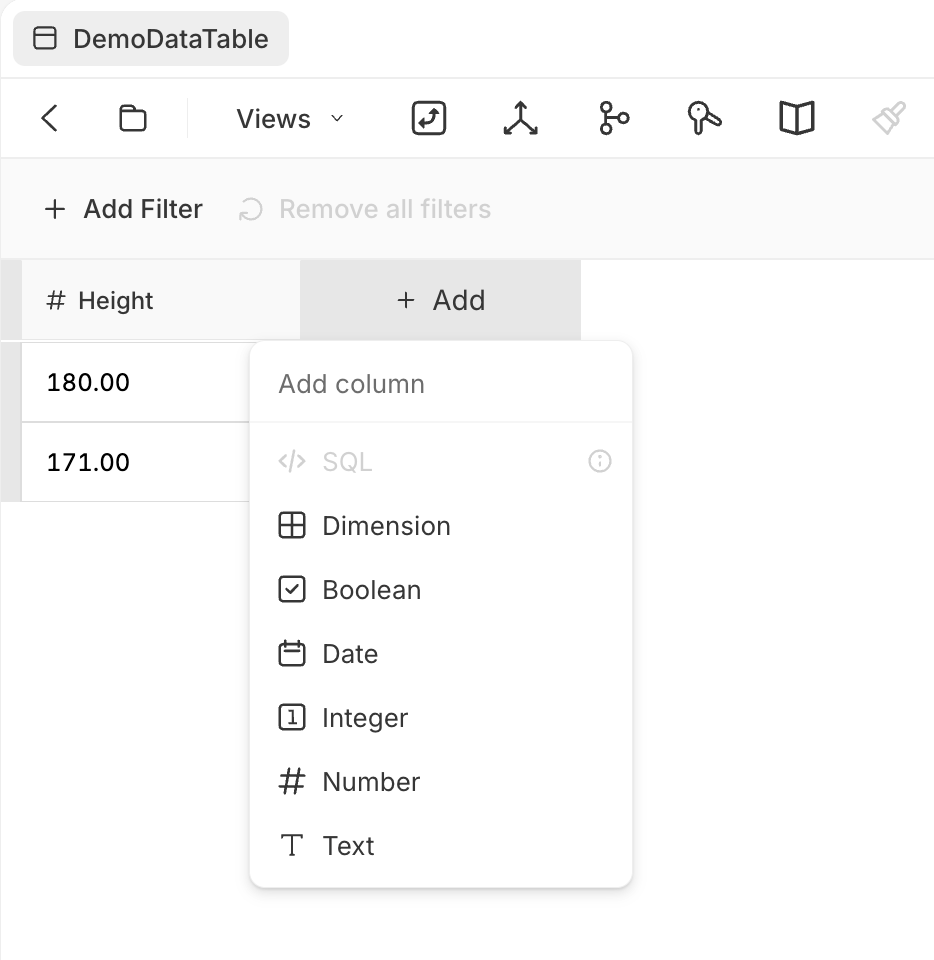
Adding a column to a data table
POST /v1/tables/{tableId}/rows
Append 1–500 rows per request; every row must include the table’s primary key column(s) (a 400 otherwise). Returns 200 when all rows apply, 207 for a partial result, or 422; a 409 means the table isn’t promoted yet. Requires the tables:append scope.
PUT /v1/tables/{tableId}/rows
Upsert rows (insert or update by key) — same 1–500 row limit and tables:append scope.
POST /v1/tables/{tableId}/ingestion-batches
Start a batched (multipart) ingestion for larger loads.
POST .../ingestion-batches/{batchId}/parts/{partNumber}/upload-url
Get a presigned URL to upload one part of a batch.
POST .../ingestion-batches/{batchId}/commit
Commit the batch to apply its rows.
DELETE .../ingestion-batches/{batchId}
Abort a batch and discard its parts. Requires the tables:append scope and confirm=true.
GET .../ingestion-batches/{batchId}
Check a batch’s status.
Coming soon
Create a data table.
⌘I
Assistant
Responses are generated using AI and may contain mistakes.